
Help us celebrate the 153rd birthday of bluejeans on May 20, 2026!
Initially, jeans were simply sturdy trousers worn by factory workers. During this period, men’s jeans had the zipper down the front, whereas women’s jeans had the zipper down the left side. Fewer jeans were made during the time of World War II, but ‘waist overalls’ were introduced to the world by American soldiers, who sometimes wore them when they were off duty. By the 1960s, both men’s and women’s jeans had the zipper down the front. Historic photographs indicate that in the decades before they became a staple of fashion, jeans generally fit quite loosely, much like a pair of bib overalls without the bib. Indeed, until 1960, Levi Strauss called its flagship product “waist overalls” rather than “jeans”.
After James Dean popularized them in the movie Rebel Without a Cause, wearing jeans became a symbol of youth rebellion during the 1950s. Because of this, they were sometimes banned in theaters, restaurants and schools. During the 1960s the wearing of jeans became more acceptable, and by the 1970s it had become general fashion in the United States for casual wear.
Michael Belluomo, editor of Sportswear International Magazine, Oct/Nov 1987, P. 45, wrote that in 1965, Limbo, a boutique in the New York East Village, was “the first retailer to wash a new pair of jeans to get a used, worn effect, and the idea became a hit.” He continued, “[Limbo] hired East Village artists to embellish the jeans with patches, decals, and other touches, and sold them for $200.” In the early 1980s the denim industry introduced the stone-washing technique developed by GWG also known as “Great Western Garment Co.” Donald Freeland of Edmonton, Alberta pioneered the method, which helped to bring denim to a larger and more versatile market. Acceptance of jeans continued through the 1980s and 1990s to the point where jeans are now a wardrobe staple, with the average North American owning seven pairs Currently, jeans may be seen worn by people of all genders and ages.
Manufacturing processes
Source: Wikipedia.org
Dyeing
Traditionally, jeans are dyed to a blue color using an indigo dye. Approximately 20 thousand tons of indigo are produced annually for this purpose, though only a few grams of the dye are required for each pair. Some other colors that can be achieved are pink, yellow, black, and white.
For more information on dyeing, refer to denim and the discussion there of using pigment dyes.
Pre-shrinking
Levi Strauss first marketed preshrunk jeans, which did not shrink further after purchase, allowing the consumer to buy his or her correct size, in 1963. These jeans were known as the 505 regular fit jeans. The 505 are almost identical to the 501s with the exception of the button-fly. The Levi’s corporation also came out with a slim bootcut fit known as 517 and 527. The difference between the two is 517 sit at the waist line and the 527 sit below the waist line. Later on, Levi’s would develop other styles and fits such as the loose, slim, comfort, relaxed, skinny, and a regular fit with a tapered leg.
Used look
The used or “acid wash” look is created by means of abrading the jeans and/or treating them with chemicals, such as acryl resin, phenol, a hypochlorite, potassium permanganate, caustic soda, acids etc.
Sandblasting or abrading with sandpaper
Consumers wanting jeans that appear worn can buy jeans that have been specially treated. To give the fabrics the worn look, sandblasting or abrading with sandpaper is often done.
Environmental and humanitarian impact
A typical pair of blue jeans consumes 919 gallons of water during its life cycle (this includes the water to irrigate the cotton crop, manufacture the jeans, and the numerous washes by the consumer).
The production of jeans with a “used look” can be more environmentally damaging than regular jeans (depending on how the waste compounds are processed). Sandblasting and treating with sandpaper has the risk of causing silicosis to the workers, and in Turkey, more than 5,000 workers in the textile industry have been stricken with this disease, and 46 people are known to have died. Some companies have announced they are banning the use of sandblasting.
Care and wear
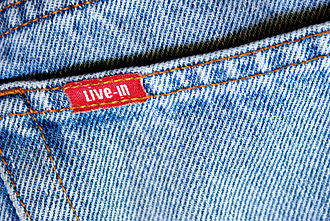
Despite most jeans being “pre-shrunk”, they are still sensitive to slightly further shrinking and loss of coloring from being washed. The Levi Strauss company recommends avoiding washing jeans as much as possible.
Carl Chiara, Levi Strauss director of brand and special projects, has a credo: The less you wash your jeans, the better your jeans become. These and other suggestions to avoid washing jeans where possible have encountered criticism. Cory Warren, editor of LS&Co. Unzipped, clarifies in a response to such a criticism: “Our advice is to wash less often, but clearly, you have to judge for yourself what’s appropriate. Hot day, dirty job? Wash your jeans. Please! Cold day, office job? Maybe you can wear them twice or more before they go back to the washing machine. Personally, if I wear a pair of jeans to work on Friday—cool climate, office job—I tend to wear them on Saturday. And if Saturday is spent indoors and I’m not spilling food all over myself, I might even wear them on Sunday.”
For those that prefer to refrain from washing their jeans, there have been suggestions to freeze them in order to kill the germs that cause odor. However, this advice has been disputed as ineffective and replaced with the suggestion of storing them for ten minutes in 250 degrees Fahrenheit.
Worldwide market for jeans
Source: wikipedia.org
The overall denim jeans market worldwide was valued at US$69.50 Bn in 2018. This market was set to grow with 3.9% CAGR during the forecast period.
The overall denim market including shirts, t-shirts, jeans and other denim products was valued at more than US$93.40 Billion in 2017. In 2018, more than 4.5 billion pairs of jeans were sold worldwide. The most prominent factor driving the denim jeans market to rise due to the recent trend to wear casual clothes in most in most workplaces. Casual wear is on account for high demand globally, especially among the younger generation.
In 2018, Europe was the leader in denim jeans market based on the geography. Europe accounts more than 30% in terms of revenue, followed by North America and the Asia-Pacific. Based on volume, Asia Pacific was the leader in denim jeans market in 2018. Asia Pacific accounts more than 40% of the market share worldwide. According to Cotton Council International (CCI) and cotton Incorporated’s global lifestyle monitor survey, “an affinity for denim is significantly high in Germany (81%) and Great Britain (68%).”
Jeans brands worldwide
Here is a listing of over 200 jean brands, manufactured and sold worldwide. Is your favorite on the list?
| Levi’s | Wrangler Jeans | Lee Jeans |
| Diesel | True Religion | Nostrum Jeans |
| Calvin Klein | Pepe Jeans London | Spykar |
| Denim BLVD. | Gesture | Killer Jeans |
| Rustler Jeans | 7 for All Mankind | Siwy |
| Lee Dungarees | Slub Jeans | Denizen |
| Basics Life | Stone Island Jeans | American Eagle |
| Big Star Jeans | Tommy Hilfiger | Mavi |
| Apple Bottoms | Riders Jeans | Mufti |
| Lee Cooper Jeans | G-Star Jeans | Guess |
| St. Johns Bay Jeans | Lucky Brand | Red Monkey |
| Miss Me | SVICA Jeans | Edwin |
| Obscene Jeans | Arizona Jeans | 5KM |
| Club Fox | Legendary Gold Jeans | Trigger |
| Nudie Jeans | US Polo Assn. | Mustang |
| PRPS | Evisu | Catch Me |
| Joe’s Jeans | Zara | Versace |
| Takeshy Kurosawa | Hollister Co. | Replay |
| Lacoste | Sanoma Jeans | Almost Famous |
| Jordache | Cheap Monday | Polo Ralph Lauren |
| Acne Jeans | April77 | Scotch & Soda |
| Oscar de la Renta | Nu Jeans | Zaab Jeans |
| LTB | Peter Says Denim | Jack & Jones |
| Monte Carlo | Miss Sixty | Salsa Jeans |
| Massimo Dutti | Silver Jeans | DC |
| Express | UNIQLO | MEK Denim |
| AG Jeans | Rifle | G10 Jeans |
| Provogue | Marithé + François Girbaud | Favo |
| Momotaro Jeans | Rock Revival | Timberland |
| Jeanswest | Bugle Boy Jeans | KR3W Denim Co. |
| McJeans | Earnest Sewn | Caesar |
| Logus Jeans | Nobody Jeans | Nautica Jeans |
| Volcom | Texas | ContoBene Jeans |
| Benetton Jeans | D Jeans London | Denim & Supply |
| Mango | LifeGate Ecojeans | Anchor Blue |
| Apii Jeans | Gap | True Icon |
| Humpty | GUESS Falcon Jeans | Ariat |
| MET | MSD Jeans | Mossimo |
| Sold Design Lab | RSQ | Ed Hardy |
| Klubture Jeans | Urban Pipeline | Flying Machine |
| Dickies | Robin Jeans | Lea Jeans |
| 77 Jeans | Denham | Thunder |
| Collin’s Jeans | Only | Big John |
| Jesus Jeans | John Player | Naked & Famous |
| Orange | Jack of Spades Jeans | Ksubi |
| Relativity Jeans | Unbranded Jeans (UB) | MPJ |
| Freego | Ravel Jeans | Buffalo David Bitton |
| Pensy Jeans | Saladgal Jeans | Bum |
| Gas Jeans | Worn Jeans | Vigoss |
| Frankie B | UMM | Siyaram |
| Stiegler | Jacob Cohen | Energie |
| Vanity | Blackbird | Time Jeans |
| Ducati | Armani Jeans | Abercrombie & Fitch |
| Loft Jeans | Jag | Denimasa |
| NSD Jeans | L.A. Idol Jeans | Numero Uno |
| Hudson Jeans | Marten Jeans | Tim’s Jeans |
| Silvertab | Yoropiko | Camaieu |
| Fuel | GSUS Jeans | Selected Homme Jeans |
| Flax | ESPRIT | Vibe |
| JX | Metro | Fidelity Denim |
| Cool Jeans | Judy Blue Jeans Co. | Elsy Jeans |
| Spidi Motorcycle Jeans | Cantabil | Welly |
| Metro Blues | Copper Jeans | Irony |
| Luigi Jeans Usa | GSP | Quiksilver |
| Louis Vuitton | Dr. Denim | Fashionista |
| Signature | DSquared2 | Wert |
| Exile Jeans | Raven | Valentino |
| Moschino Jeans | Live in | Imperial |
| Justice jeans | Kozzak |